Monday, 21 August 2017

Digital Electronics


Digital Electronics                          स                     

We know there are two types of signals, one is analog or continuous signal and the second one is Digital or discrete signal. So the science or field of research in the area of engineering is termed as Analog and Digital Electronics respectively. Now coming to the area of Digital Electronics, it is essential to understand wide range of applications from industrial electronics to the fields of communication, from micro embedded systems to military equipment. The main and perhaps the most revolutionary advantage of digital electronics is the decrease in size and the improvement in technology.This link is served by us. You do not need to download the graphic. Just highlight and copy the HTML code provided below, then paste it into the code for your Web site
We have chosen to discuss various topics of Digital Electronics from the very fundamentals of this subject such as Number systems, logic circuits going deep into those topics, like discussing various types of number systems, which we should use and how, inter relation among those number systems to the somewhat tougher concepts of Digital Electronics like TTLPMOS-NMOS logic, Flip Flops etc. to get an idea about the whole subject.
All the topics of the related articles have been amply presented by diagrams, designs, tables and examples to make every topic understandable as much as possible. The topics are written in such a manner that if one go through them he will grasp the very basic idea at first attempt and further reading will enhance the technical knowledge.
Now let us inform you what we have included in the topics of Digital Electronics, as we have already discussed we have started from the very basic topics of Digital Electronics like Number system. Then we have discussed the extension of number system like various types of number system, interrelation among different types of number systems making oneself absolutely comfortable with the fundamentals of Number system. Then we have enlightened the very important field of Digital Electronics i.e. Binary Arithmetic and Boolean algebra. And we have discussed about them in elaborated manner. From binary additionbinary subtractionbinary multiplication and binary division to the basics of Boolean algebra.
After that we have written topics about various types of codes such as ASCII codeGray CodeHamming code which have made the input output format very easy. Then various types of logic gates (AND gateOR gateNOT gateNAND gateNOR gateEX-OR gate) have been discussed in an elaborated manner with diagrams, explanations and truth tables to make each one of them very easy to understand.
These may be classified as the fundamentals of Digital Electronics without which the subject cannot be understood at all. So after discussing about them we have gone deep into the subject. Topics like TTL, Logic Families, various MOS gates, Flip Flops (J-K, D, T etc.) have been discussed.This link is served by us. You do not need to download the graphic. Just highlight and copy the HTML code provided below, then paste it into the code for your Web site
The sole purpose of introducing this subject in our Electrical Engineering website is because now days all the engineering streams are interrelated and the knowledge of Digital Electronics is very much essential for an electrical Engineer and we have tried our best to make oneself familiar with the subject technically as much as possible.  


Sunday, 20 August 2017

working principle of dc motor


Working or Operating Principle of DC Motor

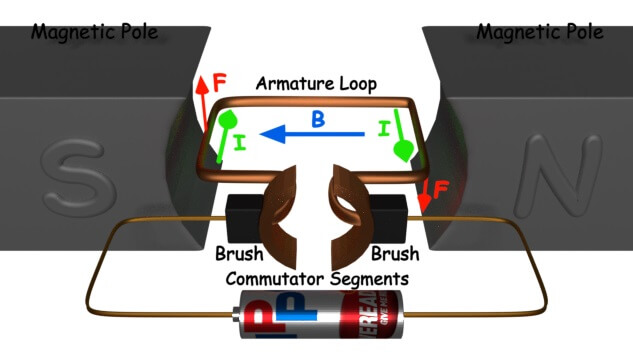
DC motor in simple words is a device that converts electrical energy (direct current system) into mechanical energy. It is of vital importance for the industry today, and is equally important for engineers to look into the working principle of DC motor in details that has been discussed in this article. In order to understand the operating principle of DC motor we need to first look into its constructional feature.dc motor partsThe very basic construction of a DC motor contains a current carrying armature which is connected to the supply end through commutator segments and brushes. The armature is placed in between north south poles of a permanent or an electromagnet as shown in the diagram above.This link is served by us. You do not need to download the graphic. Just highlight and copy the HTML code provided below, then paste it into the code for your Web site
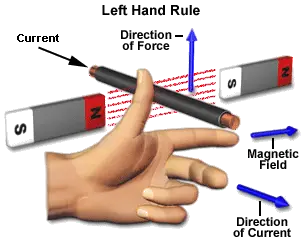
As soon as we supply direct current in the armature, a mechanical force acts on it due to electromagnetic effect of the magnet. Now to go into the details of the operating principle of DC motor its important that we have a clear understanding of Fleming’s left hand rule to determine the direction of force acting on the armature conductors of DC motor.fleming left hand ruleIf a current carrying conductor is placed in a magnetic field perpendicularly, then the conductor experiences a force in the direction mutually perpendicular to both the direction of field and the current carrying conductor. Fleming’s left hand rule says that if we extend the index finger, middle finger and thumb of our left hand perpendicular to each other, in such a way that the middle finger is along the direction of current in the conductor, and index finger is along the direction of magnetic field i.e. north to south pole, then thumb indicates the direction of created mechanical force.
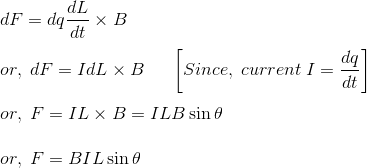
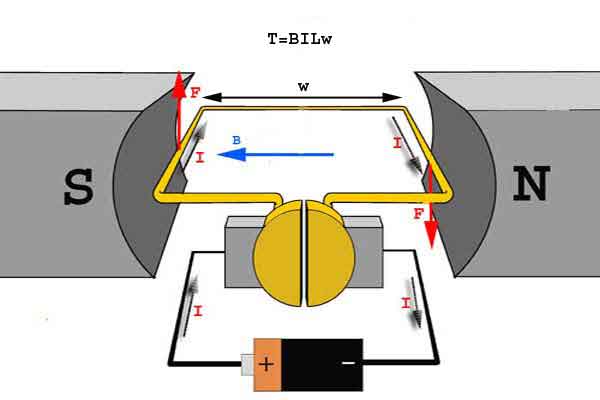
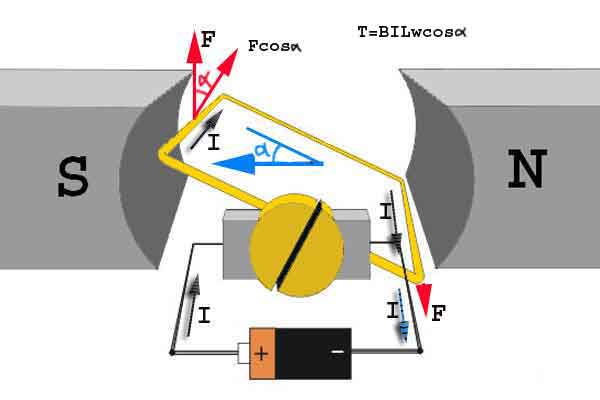
For clear understanding the principle of DC motor we have to determine the magnitude of the force, by considering the diagram below.We know that when an infinitely small charge dq is made to flow at a velocity ‘v’ under the influence of an electric field E, and a magnetic field B, then the Lorentz Force dF experienced by the charge is given by:- For the operation of DC motor, considering E = 0 i.e. it’s the cross product of dq v and magnetic field B. Where, dL is the length of the conductor carrying charge q. From the 1st diagram we can see that the construction of a DC motor is such that the direction of current through the armature conductor at all instance is perpendicular to the field. Hence the force acts on the armature conductor in the direction perpendicular to the both uniform field and current is constant. So if we take the current in the left hand side of the armature conductor to be I, and current at right hand side of the armature conductor to be -I, because they are flowing in the opposite direction with respect to each other.
Then the force on the left hand side armature conductor, Similarly force on the right hand side conductor Therefore, we can see that at that position the force on either side is equal in magnitude but opposite in direction. And since the two conductors are separated by some distance w = width of the armature turn, the two opposite forces produces a rotational force or a torque that results in the rotation of the armature conductor.
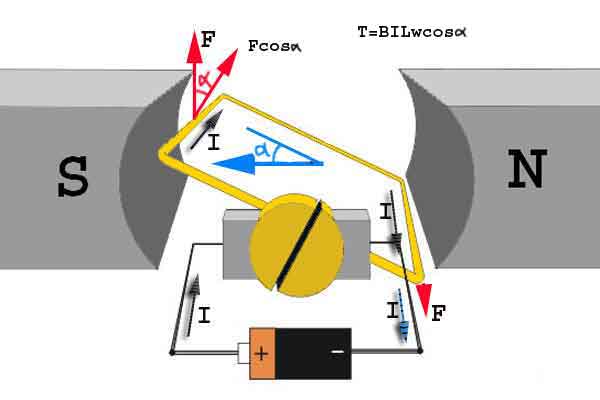
Now let's examine the expression of torque when the armature turn crate an angle of α (alpha) with its initial position.
The torque produced is given by, Where, α (alpha) is the angle between the plane of the armature turn and the plane of reference or the initial position of the armature which is here along the direction of magnetic field.
The presence of the term cosα in the torque equation very well signifies that unlike force the torque at all position is not the same. It in fact varies with the variation of the angle α (alpha). To explain the variation of torque and the principle behind rotation of the motor let us do a step wise analysis.dc motorStep 1:
Initially considering the armature is in its starting point or reference position where the angle α = 0. Since, α = 0, the term cos α = 1, or the maximum value, hence torque at this position is maximum given by τ = BILw. This high starting torque helps in overcoming the initial inertia of rest of the armature and sets it into rotation.dc motorStep 2:
Once the armature is set in motion, the angle α between the actual position of the armature and its reference initial position goes on increasing in the path of its rotation until it becomes 90o from its initial position. Consequently the term cosα decreases and also the value of torque.
The torque in this case is given by τ = BILwcosα which is less than BIL w when α is greater than 0o.basic principle of dc motorStep 3:
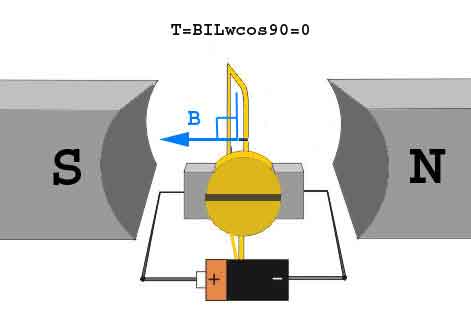
In the path of the rotation of the armature a point is reached where the actual position of the rotor is exactly perpendicular to its initial position, i.e. α = 90o, and as a result the term cosα = 0.
The torque acting on the conductor at this position is given by, dc motori.e. virtually no rotating torque acts on the armature at this instance. But still the armature does not come to a standstill, this is because of the fact that the operation of DC motor has been engineered in such a way that the inertia of motion at this point is just enough to overcome this point of null torque. Once the rotor crosses over this position the angle between the actual position of the armature and the initial plane again decreases and torque starts acting on it again.
This link is served by us. You do not need to download the graphic. Just highlight and copy the HTML code provided below, then paste it into the code for your Web site

Saturday, 19 August 2017

DC motor

What is DC Motor ?

dc machineElectrical motors are everywhere around us. Almost all the electro-mechanical movements we see around us are caused either by a AC or a DC motor. Here we will be exploring DC motors. This is a device that converts DC electrical energy to a mechanical energy.This link is served by us. You do not need to download the graphic. Just highlight and copy the HTML code provided below, then paste it into the code for your Web site

Principle of DC Motor

This DC or direct current motor works on the principal, when a current carrying conductor is placed in a magnetic field, it experiences a torque and has a tendency to move.
This is known as motoring action. If the direction of current in the wire is reversed, the direction of rotation also reverses. When magnetic field and electric field interact they produce a mechanical force, and based on that the working principle of DC motor is established.fleming left hand ruleThe direction of rotation of a this motor is given by Fleming’s left hand rule, which states that if the index finger, middle finger and thumb of your left hand are extended mutually perpendicular to each other and if the index finger represents the direction of magnetic field, middle finger indicates the direction of current, then the thumb represents the direction in which force is experienced by the shaft of the DC motor.
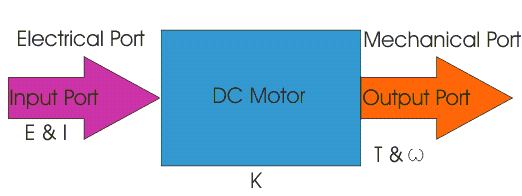
Structurally and construction wise a direct current motor is exactly similar to a DC generator, but electrically it is just the opposite. Here we unlike a generator we supply electrical energy to the input port and derive mechanical energy from the output port. We can represent it by the block diagram shown below.dc motorHere in a DC motor, the supply voltage E and current I is given to the electrical port or the input port and we derive the mechanical output i.e. torque T and speed ω from the mechanical port or output port.
The input and output port variables of the direct current motor are related by the parameter K. So from the picture above we can well understand that motor is just the opposite phenomena of a DC generator, and we can derive both motoring and generating operation from the same machine by simply reversing the ports.

Detailed Description of a DC Motor

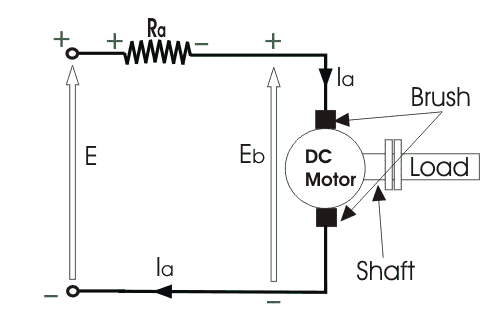
To understand the DC motor in details lets consider the diagram below,dc motorThe direct current motor is represented by the circle in the center, on which is mounted the brushes, where we connect the external terminals, from where supply voltage is given. On the mechanical terminal we have a shaft coming out of the Motor, and connected to the armature, and the armature-shaft is coupled to the mechanical load. On the supply terminals we represent the armature resistance Ra in series. Now, let the input voltage E, is applied across the brushes. Electric current which flows through the rotor armature via brushes, in presence of the magnetic field, produces a torque Tg. Due to this torque Tg the dc motor armature rotates. As the armature conductors are carrying currents and the armature rotates inside the stator magnetic field, it also produces an emf Eb in the manner very similar to that of a generator. The generated Emf Eb is directed opposite to the supplied voltage and is known as the back Emf, as it counters the forward voltage.
The back emf like in case of a generator is represented by Where, P = no of poles
φ = flux per pole
Z= No. of conductors
A = No. of parallel paths
and N is the speed of the DC Motor.
So, from the above equation we can see Eb is proportional to speed ‘N’. That is whenever a direct current motor rotates, it results in the generation of back Emf. Now lets represent the rotor speed by ω in rad/sec. So Eb is proportional to ω.
This link is served by us. You do not need to download the graphic. Just highlight and copy the HTML code provided below, then paste it into the code for your Web site

So, when the speed of the motor is reduced by the application of load, Eb decreases. Thus the voltage difference between supply voltage and back emf increases that means E − Eb increases. Due to this increased voltage difference, armature current will increase and therefore torque and hence speed increases. Thus a DC Motor is capable of maintaining the same speed under variable load.
Now armature current Ia is represented by Now at starting,speed ω = 0 so at starting Eb = 0. Now since the armature winding electrical resistance Ra is small, this motor has a very high starting current in the absence of back Emf. As a result we need to use a starter for starting a DC Motor.
Now as the motor continues to rotate, the back Emf starts being generated and gradually the current decreases as the motor picks up speed.

Types of DC Motors

Direct motors are named according to the connection o the field winding with the armature. There are 3 types:
  1. Shunt wound DC motor
  2. Series wound DC motor
  3. Compound wound DC motor

    Speed Regulation of DC Motor


    On application of load the speed of a DC motor decreases gradually. This is not at all desirable. So the difference between no load and full load speed should be very less. The motor capable of maintaining a nearly constant speed for varying load is said to have good speed regulation i.e the difference between no load and full load speed is quite less. The speed regulation of a permanent magnet DC motor is good ranging from 10 - 15% whereas for DC shunt motor it is somewhat less than 10 %. DC series motor has poor value of regulation. In case of compound DC motor for DC cumulative compound the speed regulation is around 25 % while differential compound has its excellent value of 5 %.

    Speed of a DC Motor

    The emf equation of DC motor is given by Here,
    N = speed of rotation in rpm.
    P = number of poles.
    A = number of parallel paths.
    Z = total no. conductors in armature.
      Hence, speed of a DC motor is directly proportional to emf of rotation (E) and inversely proportional to flux per pole (φ).

    Speed Regulation of a DC Motor

    The speed regulation is defined as the change in speed from no load to full load, expressed as a fraction or percentage of full load speed.
    Therefore, as per definition per unit (p.u) speed regulation of DC motor is given as, Similarly, percentage (%) speed regulation is given as, Where,Therefore,A motor which has nearly constant speed at all load below full rated load, have good speed regulation.This link is served by us. You do not need to download the graphic. Just highlight and copy the HTML code provided below, then paste it into the code for your Web site
  4. Speed Control of DC Motor


    Speed control means intentional change of the drive speed to a value required for performing the specific work process. Speed control is a different concept from speed regulation where there is natural change in speed due change in load on the shaft. Speed control is either done manually by the operator or by means of some automatic control device.One of the important features of DC motor is that its speed can be controlled with relative ease. We know that the emf equation of DC motor is given as, N = 60A E / PZØ
    N = E / kØ
    where, k = PZ/60A
    N = V - Ia Ra / kØ
    Therefore speed (N) of 3 types of DC motor – SERIES, SHUNT and COMPOUND can be controlled by changing the quantities on RHS of the expression. So speed can be varied by changing
    1. Terminal voltage of the armature V.
    2. External resistance in armature circuit Ra.
    3. Flux per pole φ.
    The first two cases involve change that affects armature circuit and the third one involves change in magnetic field. Therefore speed control of DC motor is classified as
    1. Armature control methods
    2. Field control methods.

    Speed Control of DC Series Motor

    Speed control of DC series motor can be done either by armature control or by field control.

    Armature Control of DC Series Motor

    Speed adjustment of DC series motor by armature control may be done by any one of the methods that follow,
    1. Armature Resistance Control Method: 
      This is the most common method employed. Here the controlling resistance is connected directly in series with the supply of the motor as shown in the fig.armature resistance control methodThe power loss in the control resistance of DC series motor can be neglected because this control method is utilized for a large portion of time for reducing the speed under light load condition. This method of speed control is most economical for constant torque. This method of speed control is employed for DC series motor driving cranes, hoists, trains etc.
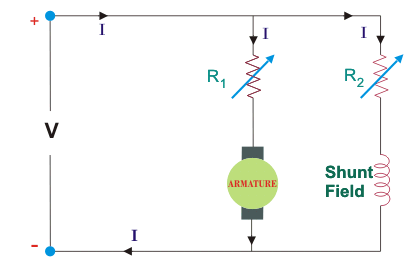
    2. Shunted Armature Control: 
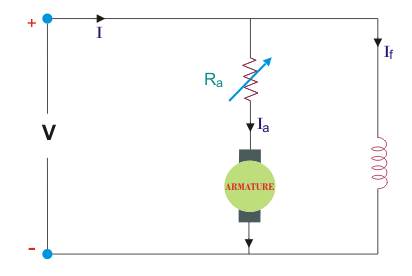
      The combination of a rheostat shunting the armature and a rheostat in series with the armature is involved in this method of speed control. The voltage applied to the armature is varies by varying series rheostat R1. The exciting current can be varied by varying the armature shunting resistance R2. This method of speed control is not economical due to considerable power losses in speed controlling resistances. Here speed control is obtained over wide range but below normal speed.
    3. shunted armature control
    4. Armature terminal voltage control: 
      The speed control of DC series motor can be accomplished by supplying the power to the motor from a separate variable voltage supply. This method involves high cost so it rarely used.

    Field Control of DC Series Motor

    The speed of DC motor can be controlled by this method by any one of the following ways –
    1. Field Diverter Method
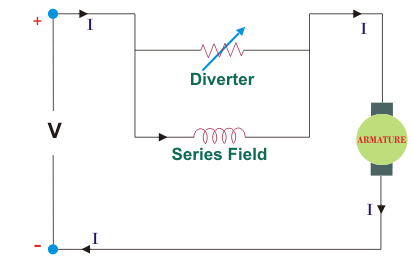
      This method uses a diverter. Here the field flux can be reduced by shunting a portion of motor current around the series field. Lesser the diverter resistance less is the field current, less flux therefore more speed. This method gives speed above normal and the method is used in electric drives in which speed should rise sharply as soon as load is decreased.
    2. field diverter method
    3. Tapped Field Control
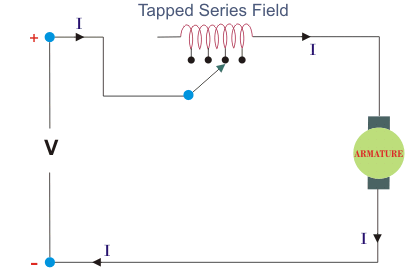
      This is another method of increasing the speed by reducing the flux and it is done by lowering number of turns of field winding through which current flows. In this method a number of tapping from field winding are brought outside. This method is employed in electric traction.
    tapped field control

    Speed Control of DC Shunt Motor

    Speed of DC shunt motor is controlled by the factors stated below

    Field Control of DC Shunt Motor

    By this method speed control is obtained by any one of the following means –
      1. In this method, speed variation is accomplished by means of a variable resistance inserted in series with the shunt field. An increase in controlling resistances reduces the field current with a reduction in flux and an increase in speed. This method of speed control is independent of load on the motor. Power wasted in controlling resistance is very less as field current is a small value. This method of speed control is also used in DC compound motor.This link is served by us. You do not need to download the graphic. Just highlight and copy the HTML code provided below, then paste it into the code for your Web site
    1. Limitations of this Method of Speed Control
      • Creeping speeds cannot be obtained.
      • Top speeds only obtained at reduced torque.
      • The speed is maximum at minimum value of flux, which is governed by the demagnetizing effect of armature reaction on the field.
    2. Field Voltage Control

      This method requires a variable voltage supply for the field circuit which is separated from the main power supply to which the armature is connected. Such a variable supply can be obtained by an electronic rectifier.

    Armature Control of DC Shunt Motor

    Speed control by this method involves two ways. These are :
    1. Armature Resistance Control

      In this method armature circuit is provided with a variable resistance. Field is directly connected across the supply so flux is not changed due to variation of series resistance. This is applied for DC shunt motor. This method is used in printing press, cranes, hoists where speeds lower than rated is used for a short period only.
    2. Armature Voltage Control

      This method of speed control needs a variable source of voltage separated from the source supplying the field current. This method avoids disadvantages of poor speed regulation and low efficiency of armature-resistance control methods. The basic adjustable armature voltage control method of speed d control is accomplished by means of an adjustable voltage generator is called Ward Leonard System. This method involves using a motor-generator (M-G) set. This method is best suited for steel rolling mills, paper machines, elevators, mine hoists, etc. This method is known as Ward-Leonard System. 
      Advantages
      1. Very fine speed control over whole range in both directions
      2. Uniform acceleration is obtained
      3. Good speed regulation
      4. It has regenerative braking capacity
      Disadvantages
      1. Costly arrangement is needed , floor space required is more
      2. Low efficiency at light loads
      3. Drive produced more noise.

      Solid State Speed Control

      Static Ward Leonard drives are being used these days because of the drawbacks of the classical method. Rotating M-G sets are replaced by solid state converters to control DC motor speed. The converters used are choppers (in case of DC supply) or controlled rectifiers (in case of AC supply). This method is not suitable for intermittent loads.

Digital Electronics

Digital Electronics                          स                      We know there are two types of signals, one is analog or continuou...